Portfolio
From enterprise-scale data platforms to small-business commerce builds — a look at the systems behind the work, and the rigor that goes into them.
The enterprise data work behind Framework & Co. — modernizing the system that tells a major financial institution how profitable its customers are. It's the same discipline now brought to small-business AI and data projects.
Enterprise data architecture
A large financial institution calculated customer profitability across credit, fee, and deposit products on aging data infrastructure — costly to run, hard to audit, and slow to change as the business evolved.
Architect and lead the redesign: profile the source systems, model the data, and rebuild the profitability platform on a modern data landing zone — with every figure reconciled from source to the enterprise general ledger.
A modern, auditable platform where profitability metrics are accurate, traceable to the dollar, and far easier to extend — trusted to support decisions across the business.
Banks live and die by knowing which customers and products actually make money. At this institution, those answers came out of a sprawling legacy analytics platform that pulled from dozens of source systems across credit, fees, and deposits — then rolled everything up into customer profitability.
The platform worked, but it was expensive to maintain, difficult to audit, and brittle whenever the business needed something new. Tracing a single number back to its source could mean digging through layers of undocumented logic. As reporting and regulatory expectations grew, the old architecture became a liability rather than an asset.
The job was to redesign and rebuild the platform on modern data infrastructure — without ever breaking trust in the numbers. That started with deep data profiling: understanding exactly what each source system held, how it behaved, and how it should map into the new model.
From there came the architecture — modeling credit, fee, and deposit data into a clean, well-documented structure, writing the functional specifications and data maps the development teams built against, and standing the whole thing up in a modern data landing zone to replace the legacy environment.
The non-negotiable was accuracy. Every financial figure was validated and reconciled from its source all the way to the enterprise general ledger, so profitability calculations could be trusted and audited line by line. The effort spanned business, finance, and technology partners — and a team of consultants — kept aligned around one version of the truth.
You don't run a bank. But the discipline that keeps a bank's numbers trustworthy is exactly what makes AI and automation actually useful for a small business: clean, well-modeled data; systems you can trace and trust; and a translator who can move between "what the business needs" and "what the technology does."
That's the foundation Framework & Co. is built on. The same rigor that modernized an enterprise profitability platform now goes into right-sized projects — organizing your data, wiring in the right AI tools, and building systems that hold up — explained in plain language, and yours to own.
Client and identifying details are withheld under confidentiality. This entry describes the nature and scale of the work behind Framework & Co., not a Framework & Co. client engagement.
A subscription and ordering platform built from scratch for a small artisan bakery — so the owner could stop managing orders by hand and start growing.
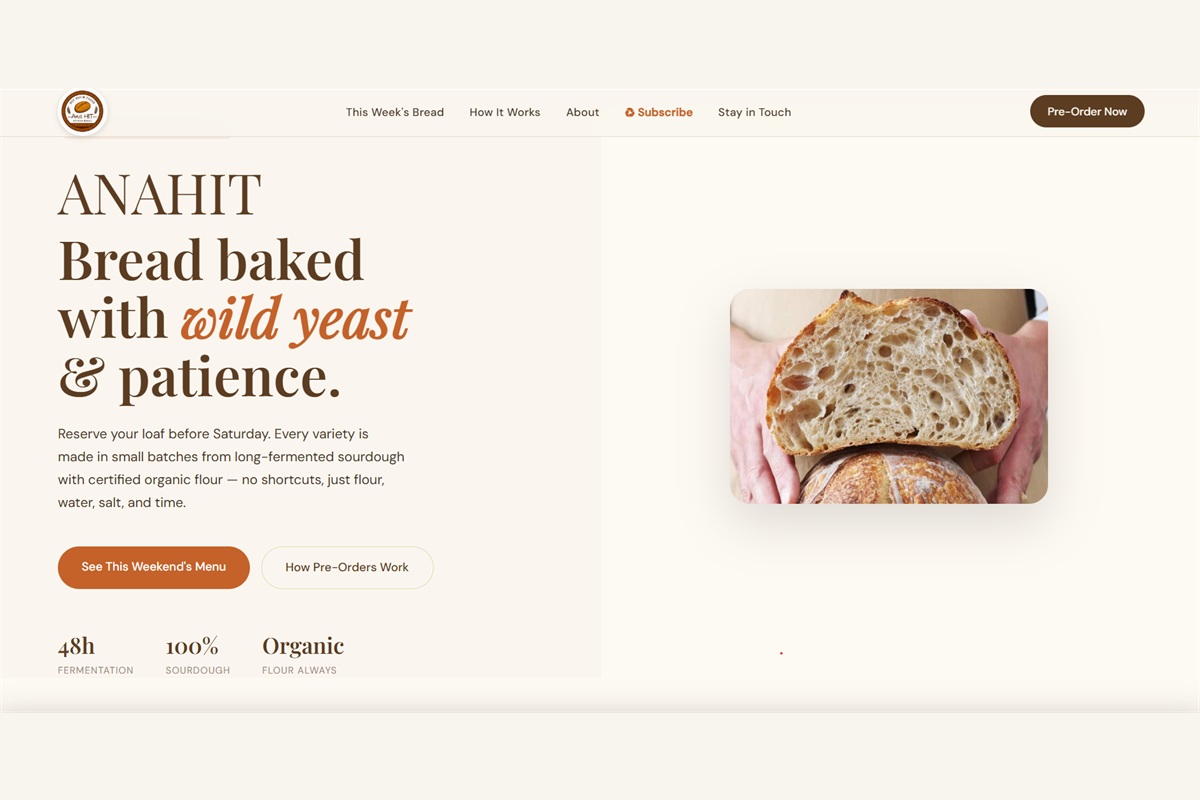
A growing bakery was managing weekly subscription orders manually — spreadsheets, DMs, and payment follow-ups were eating hours every week and leaving room for missed orders.
A custom subscription and ordering platform with online checkout, automated billing, email notifications, and an admin dashboard built specifically for how the bakery operates.
Orders process automatically. Customers manage their own subscriptions. The owner runs the whole system from one dashboard — and spends that reclaimed time on baking.
Anahit Bakery had built a loyal base of weekly subscribers — customers who wanted a fresh box of pastries delivered or ready for pickup every week. But the process of managing those orders was entirely manual.
Every week meant tracking who had paid, chasing down missed payments, updating a spreadsheet, and fielding messages from customers who wanted to pause, skip, or change their order. It worked — barely — but it wasn't sustainable as the customer base grew. A single missed message could mean a missed order or an awkward conversation.
What the bakery needed wasn't a generic e-commerce platform. It needed a system built around how it actually operated: recurring weekly orders, flexible pickup options, and an owner who didn't want to think about software every Monday morning.
A custom end-to-end subscription and ordering platform, built specifically for Anahit Bakery's workflow. Customers can browse, subscribe, and check out directly on the site. Payments process automatically on a weekly cycle, and subscribers receive confirmation and reminder emails without any manual involvement from the owner.
The subscriber portal lets customers manage their own accounts — pausing a week, updating their pickup preference, or cancelling entirely — without needing to message the bakery. That alone cut a significant portion of the weekly admin load.
On the owner's side, a purpose-built admin dashboard shows the week's orders at a glance: who's subscribed, what they've ordered, and what's been paid. Everything the owner needs to prep and fulfil orders, in one place, without digging through a spreadsheet.
The whole system was built as a progressive web app, so it installs like a native app on the owner's phone — making it easy to check the dashboard from anywhere.
The bakery launched with its full subscriber base migrated over and orders processing automatically from day one. Within the first month, the owner reported spending a fraction of the time on order management compared to the old process — and zero missed orders.
Customers appreciated being able to manage their subscriptions directly. The self-serve portal removed a whole category of back-and-forth messages, and the automated billing meant no more awkward payment follow-ups.
See it live
Visit anahitbakery.comIn her words
“Before Framework & Co., every week meant chasing payments, updating spreadsheets, and answering messages about orders. Oz built us a custom system where customers manage their own subscriptions and billing happens automatically. Now I just open one screen to see the whole week. He explained everything in plain language and never made me feel behind on the tech.
What really sets Oz apart is that his support didn’t stop when the project was completed. He continues to be available to answer questions, respond quickly whenever assistance is needed, and help maintain the website. Knowing that I can rely on ongoing support gives me tremendous peace of mind. I would highly recommend him to any small business looking for a reliable, knowledgeable partner who truly cares about their success.”

An online store and custom-order system for a New York specialty bakery — giving a Tres Leches cake maker one place to sell to retail customers, restaurants, and custom-occasion clients across Manhattan and the Bronx.
Vanessa's lactose-free Tres Leches cakes had real demand — from walk-up customers, restaurants, and people ordering custom cakes for celebrations — but every order came in by phone and DM, with no online storefront and no structured way to capture custom requests.
A custom online cake store with an order builder, a dedicated custom-order flow, automated confirmations, and an admin dashboard — built around how Vanessa actually bakes, sells, and delivers across Manhattan and the Bronx.
Customers now browse, customize, and order online any time. Retail, restaurant, and custom-occasion orders all flow into one system, and Vanessa runs the whole operation from a single dashboard.
La Cosinita de Vanessa had built a name as one of New York's Tres Leches specialists — a Dominican recipe refined over years, made fresh to order, and (unlike most) fully lactose-free. Demand was coming from three different directions: retail customers wanting a cake for the week, restaurants buying for resale, and people ordering custom cakes for birthdays, parties, and special occasions.
But all of that ran through phone calls and Instagram DMs. There was no online storefront, no menu customers could order from on their own, and no structured way to take in a custom request. Every order meant a back-and-forth conversation to nail down size, flavor, delivery, and payment — and the details lived in message threads rather than in one place.
What Vanessa needed wasn't a generic store template. She needed a system that fit a made-to-order bakery: one that could sell standard cakes, handle genuinely custom orders, and keep retail and restaurant business organized without adding hours of admin to every week.
A custom online cake store, built specifically for La Cosinita de Vanessa. Customers can browse the menu — Tres Leches, Chocoflan, cheesecake, flan, and shooters — choose a size and flavor through an order builder, and check out securely online, without a single DM.
For anything beyond the standard menu, a dedicated custom-order flow captures the details of an occasion cake up front, so a request arrives structured and ready rather than scattered across messages. Customers receive automatic confirmation, and Vanessa follows up to finalize the design — without the order ever getting lost.
Behind the scenes, a purpose-built admin dashboard brings every order — retail, restaurant, and custom — into one view, so Vanessa can see what's been ordered and what needs baking at a glance. A gallery showcases past work to win new custom clients.
The whole system was built as a progressive web app, so it installs like a native app on Vanessa's phone — making it easy to manage orders and deliveries across Manhattan and the Bronx from anywhere.
La Cosinita de Vanessa now has a real online home. Customers place and customize their own orders around the clock, custom-occasion requests come in complete instead of as open-ended messages, and the retail and restaurant side is finally organized in one system rather than scattered across a phone.
Instead of running a bakery out of an inbox, Vanessa runs it from a single dashboard — and gets to spend that reclaimed time where it matters: baking.
See it live
Visit lacosinitadevanessa.comIn her words
“Working with Oz was an exceptional experience. From the outset, the process was seamless and enjoyable. They transformed my vision for La Cosinita de Vanessa into reality more quickly than I anticipated, all while maintaining a high level of professionalism. I couldn’t be happier with the outcome!”
A fast, fully-owned commerce site for a Fort Mill acai bowl shop and mobile truck — with a custom bowl builder and the same Square checkout framework behind Anahit Bakery, ready to take orders online.
Maui Acai runs a Downtown Fort Mill shop and a mobile truck for events, but needed a faster, fully-owned website — one that showcased the brand, drove truck bookings, and could host its own online ordering instead of leaning on a generic site builder.
A custom, mobile-first site built on the same commerce framework as Anahit Bakery: branded pages, a bowl-customizer ordering system, Square checkout wired in, a truck-booking flow, and Square e-gift cards.
Maui Acai now owns a fast, branded site with online ordering built in and ready to switch on — plus truck-booking inquiries and gift card sales running through one system.
Maui Acai had built a real local following in Fort Mill, South Carolina — small-batch acai bowls from a Downtown shop, plus a mobile truck that shows up for school events, sports tournaments, offices, and community gatherings. Two ways to reach customers, and growing demand for both.
But the web presence didn't match the brand. The site lived on a generic builder, it wasn't as fast or as polished as the bowls deserved, and there was no online ordering of their own — every sale still happened in person, and every truck booking started as a phone call or email with no real structure behind it.
What Maui Acai needed was a site it fully owned: fast, mobile-first, on brand, and built to host its own ordering system rather than depending on a third-party platform or paying a marketplace to sit between the shop and its customers.
A custom, mobile-first commerce site built on the same framework powering Anahit Bakery. The build covers a brand-forward home page, a full menu, a dedicated mobile-truck page, and a contact and booking flow — all fast, installable as a progressive web app, and owned entirely by Maui Acai.
At the center is a bowl-customizer ordering system: customers build a bowl, choose add-ons, and add it to a cart, with the same Square checkout framework used for Anahit wired in behind it — so turning on live online ordering is a switch to flip, not a system to build.
The mobile-truck page channels event requests into a structured booking flow instead of scattered phone tag, and Square e-gift cards are available for purchase today. The contact form runs on Netlify, ready to collect catering and event inquiries the moment they come in.
Maui Acai now owns a fast, polished, mobile-first site that finally looks the way the brand tastes — and, crucially, one with a complete ordering system built in. The Square checkout framework is in place and ready to go live, so the shop can start taking online orders without another build cycle.
In the meantime, truck-booking inquiries and gift card sales already run through the site, giving Maui Acai a single, owned home for everything from a weekend bowl to a full event booking.
Maui Acai started on a generic Wix site. Here's how the old presence compares to the custom build.
See it live
Visit mauiacai1.netlify.appMore work
Every project I take on is a potential case study — with client permission. Check back as the portfolio grows.
Putting AI to work on the repetitive tasks eating a small business's week.
Turning scattered business data into one clean, connected view worth acting on.
Connecting the tools a business already uses so they finally talk to each other.
Let's talk about what you need. Discovery calls are free, no-pressure, and a good use of 30 minutes.
Get in touch